2026 PhotoALLIANCE PORTFOLIO REVIEW
Meet the People Who Shape Photography in Northern California
Saturday, October 10, 2026
11 am - 7 pm
Harvey Milk Photo Center
50 Scott St, San Francisco, CA
PORTFOLIO REVIEW TIPS & BEST PRACTICES
PhotoAlliance hosts annual portfolio reviews, geared toward photographers who want to push their work to the next level by getting feedback from industry leaders. Our review features curators, gallerists, artists, educators, art historians, publishers, designers, and more, with much of the talent located here in our San Francisco Bay Area.
So, What is a Portfolio Review for?
At its core, a portfolio review is a series of one-on-one conversations about your work. It is also an opportunity to connect to the greater photo community, meet peers, and explore opportunities.
A portfolio review isn't necessarily about getting a show, a gallery representation, or green light for a publication.
It's a chance to:
Get an informed outside perspective on your work
Talk through your ideas and creative process
Understand how someone unfamiliar with the project responds to it
Receive feedback on editing, sequencing, and presentation
Learn about potential exhibition, publishing, or other relevant opportunities
Meet people whose interests and expertise may intersect with your work
Better understand where your work fits within the larger photographic community
Practice articulating what you're making and why
Key takeaway: Go in curious, and see what you can learn, without expecting a particular outcome.
Know What You Want From the Review
Before choosing reviewers or preparing your portfolio, ask yourself:
What kind of feedback am I looking for?
Am I looking for a curator's perspective?
Do I want help thinking about exhibitions and exhibition opportunities?
Do I want sequencing guidance?
Am I interested in publishing, or am I seeking a publisher?
Do I want an editor's perspective?
Am I looking for connections within a particular photographic community?
Am I simply trying to understand how my work is being received?
Key takeaway: “By the end of this review, I'd love to have a better understanding of ______.”
Research Your Reviewers
Research:
What organizations do they work with?
What artists have they exhibited, published, represented, or written about?
What kinds of photography interest them?
What projects have they worked on recently?
Do they work in the area you are hoping to enter?
Key takeaway: Keep the reviewer’s background and their possible connections or insight into your work in mind when selecting reviewers. A well-known reviewer may have good insight, but also consider your path, goals, and if they
Edit Your Portfolio Ruthlessly
Your portfolio should feel like a body of work, rather than “a little bit of this and that”, or a collection of favorite photographs.
Consider:
Cohesion
Sequencing
Visual rhythm
Consistency of intention
Strong opening image
Strong closing image
Eliminating weaker or redundant images
Showing enough work to communicate the project without overwhelming the reviewer
A typical review focuses on 1-2 projects, prioritizing 1 of them, since time available with each reviewer is limited.
The projects you present and the images in them are a supporting argument to show the work. Your portfolio edit should communicate what the project is, and not a compendium of your artistic range.
Key takeaway: The images in your portfolio share the story of your work; each should support the body of work, and your artist statement.
Set Your Sequence
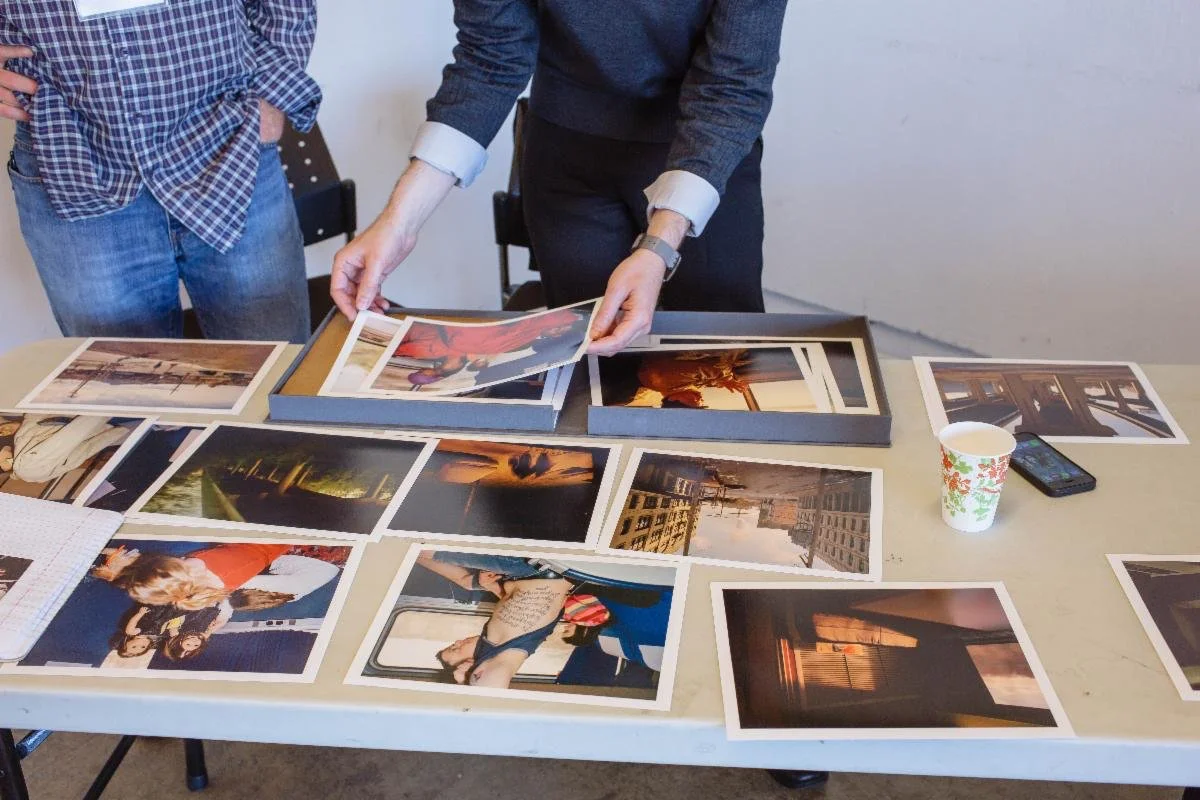
To make reviewing prints and walking through the sequence easier each time:
Prep a set of prints that are okay to be handled by multiple people during the review — if you’re showing originals or you prefer to be the only person handling your prints, make sure your reviewer knows!
Include an index print with thumbnails in order
Lay out your prints in the order you plan to share them
Use a pencil to number the prints on the verso, on a rear corner of each print
Setting an order and recording it on print backs helps you easily reorganize prints to prep for your next review. It also means reviewers can help adjust sequencing or refer back to individual prints without increasing your reorganization time before your next review.
Key takeaway: Numbered print sequencing saves your time and your reviewers, allowing you to be ready for your next review with less stress.
Know Your Work, But Don't Memorize a Script
Artists should be able to talk about:
What the project is
Why they made it
What questions they're exploring
How the work developed
What they're working on now
Where they see the project going
What they’d like guidance or help with
A reviewer should be able to ask questions and have an intelligent, meaningful conversation with you about your work. You are human, and so is your reviewer. Your reviewer knows this! Approach these conversations with comfort, and from a place of knowledge.
If you’re showing serious, personal, or conceptually complex work, don’t feel like you need to arrive with a fully packaged explanation that tells the reviewer what they’re supposed to think.
Key takeaway: Prepare by practicing talking about your work, and then relax — you know your work intimately. After all, you made it! Nobody else will know it better.
Prep a 2-Minute Introduction
Your verbal introduction to the project should be brief, conversational, and introduce the background on the project, or your headspace when you began it.
Consider including:
What the work is
Why you made it
What you are investigating with it
What you are hoping to achieve, or to do with it next
Consider starting with:
“This project began when…”
“I’m interested in…”
“These photographs explore…”
“I’m currently thinking about…”
“I started this project while I was going through…”
If you find yourself nervous, or if this is your first review, feel free to say so.
Key takeaway: Your words provide the starting point for exploring your work. Then, walk the reviewer through your prints.
During the Review: Let the Reviewer Look
Don't rush to fill every silence.
Give the reviewer time to:
Look
Turn pages
Ask questions
Sit with an image
Respond naturally
And listen.
Key takeaway: A portfolio review is a conversation between the reviewer and yourself, not a presentation followed by a Q&A.
Ask Insightful Questions
Instead of asking “What do you think?”, suggest questions that generate useful information:
Which images stay with you?
Where does the project feel strongest?
Where does it lose momentum?
Does the sequencing make sense?
What questions does this work raise for you?
How would you describe this project to someone who hasn't seen it?
Do you see opportunities for this work that I may not be considering?
What would you edit?
Is there something you wish you saw more of?
If a reviewer makes a suggestion, ex. “You should talk to ______ institution about your work.”, ask for one or two names there who would be interested in seeing it. You might also ask if they’d be willing to share contact info or introduce you, if they were inclined.
Key takeaway: Ask reviewers questions that will help you, that they might also have insight on or knowledge about.
Be Open to Feedback, Even When You Disagree
A reviewer's response is one informed perspective, not a verdict on the work. Don’t expect everyone to love your work. You may hear contradictory feedback from eight reviewers. That's normal.
Instead of asking: “Who is right?”
Ask: “What can I learn from the fact that these people are responding differently?”
This also gives you an opportunity to explain that different reviewers bring different contexts, tastes, professional experiences, and areas of expertise. If the reviewer has an opinion or recommendation that diverges from your vision, ask them why.
Treat reviewer feedback as something to consider, not as an instruction that must be followed.
Key takeaway: You will gain valuable feedback — and learn where your work has traction.
Respect the Time Clock
The review is 20 minutes:
Start promptly
Don't spend half the session on your biography
Keep the conversation moving
Watch for time cues (5 minute warning!)
Begin wrapping up when the session is ending
Don't assume an extra five minutes
Key takeaway: Focus on what you want from the session, and on getting feedback. Respect the reviewer’s time by respecting the time you have with them.
Take Notes! Don't Try to Remember Everything
Bring a way to take notes. It could be your phone, a legal pad, your notebook, etc.
After each review, write down:
What they responded to
Images they mentioned
Suggestions they made
Names of people they recommended
Publications/galleries/projects mentioned
Your own reactions
Don't rely on memory at the end of a long day. Jot relevant comments down promptly, before the details fade. Refer to print numbers on your index sheet if it helps.
Pro-tip: Ask the reviewer for permission to audio-record the session, so you can review with notes later.
Key takeaway: Taking notes helps you make the most of your review, after the review. Review your notes later, and look for patterns across conversations.
The Review Doesn't End When You Leave the Table
Follow up with reviewers when appropriate.
Don't send a generic mass email to all of your reviewers, thanking them for their time. If they suggested a specific person, publication, gallery, or opportunity, mention it.
A good follow-up might say:
Thank you for taking the time to look at my work. I especially appreciated your thoughts about ______. I wanted to follow up with you about ______.
Key takeaway: Don't expect an immediate opportunity. The goal is to begin a professional relationship, and develop it over time.
Bring a Leave-Behind, And Make It Useful
Consider leaving each reviewer with your:
Business card
Small postcard showing your work
One-sheet page with info about your work or exhibition history
QR code to website
Project PDF
Artist website
Make sure you include:
Name
Website
Email
Project title
Instagram/social, if relevant
PhotoAlliance will provide reviewers with your portfolio review submission packet, but your one-on-one review and leave-behinds can leave a lasting personal impression.
Have your online presence up to date before you arrive.
Key takeaway: Bring something that is reflective of your work that reminds the reviewer of your project or discussion when they see it.
Take Care of Yourself
Reviews are exhausting. It’s a long day, and it can be an intense experience!
You’ll be:
Meeting tons of new people
Looking at hundreds of photographs
Talking about deeply personal work
Receiving contradictory feedback
Making professional connections all day
Keeping track of:
Your portfolio
Your notes
Connections you make along the way
So:
Try to rest well before the review!
Eat
Drink water
Take breaks
Step outside
Don't compare your review experience to someone else's
Give yourself time to process after the review
PhotoAlliance is stocking a break room with coffee and snacks, providing lunch, and offering refreshments throughout the day. Take advantage of them! If you want something particular, or have a food item that helps you settle back into feeling at home, bring it!
Key takeaway: Pace yourself, take breaks when needed, and enjoy!
REMEMBER: A Portfolio Review Is One Moment in a Long Career
One review or review day isn’t a total verdict on your work, or the end of your artistic path.
You might leave energized. You might leave confused. You might hear something that completely changes how you think about your project, or something you strongly disagree with. The goal isn't to make every reviewer love your work.
The goal is to put your work into conversation with people who can help you see it differently, and prepare your work for the next steps in your career.
From all of us at PhotoAlliance, we wish you a happy and successful review! Onward!
ABOUT HARVEY MILK PHOTO CENTER
50 Scott St, San Francisco, CA 94117
Get directions HERE
The 2026 PhotoAlliance Portfolio Review will be held at the Harvey Milk Photo Center, located on the bottom floor of 50 Scott Street, a building shared with the Harvey Milk Center for the Arts. The entrance to the Photo Center faces Duboce Park, facing east. If you approach from the west (Divisadero, Scott streets), you can take the ramp or stairs on north and south sides of the building respectively.
Established in 1940, the Harvey Milk Photo Center has been serving the San Francisco community for over eight decades. As the oldest and largest community wet darkroom in the United States, they are proud to be associated with and managed by the San Francisco Recreation & Parks Department. Their offerings extend to a full digital lab, available to their members. The Photo Center has been at 50 Scott Street in San Francisco since 1954, within Duboce Park on the lower level of the Harvey Milk Center for the Arts building.
SPONSORS

Sandy's is a New Orleans-inspired muffuletta shop at 1457 Haight Street in the heart of San Francisco's Haight-Ashbury neighborhood. Founded by New Orleans native Peterson Harter, Sandy's has built a loyal community on one of San Francisco's most iconic streets — one sandwich at a time. Our muffulettas are stacked high with imported soppressata, mortadella, prosciutto, and provolone, finished with a spicy olive spread and baked on sesame bread. Named #23 in the San Francisco Chronicle's Top 100 Bay Area Restaurants, Sandy's is more than a sandwich shop — it's a gathering place that celebrates the pleasures of good food and good company.
CONTACT
If your question wasn’t answered above, please email questions to review@photoalliance.org. We will respond as soon as possible.